

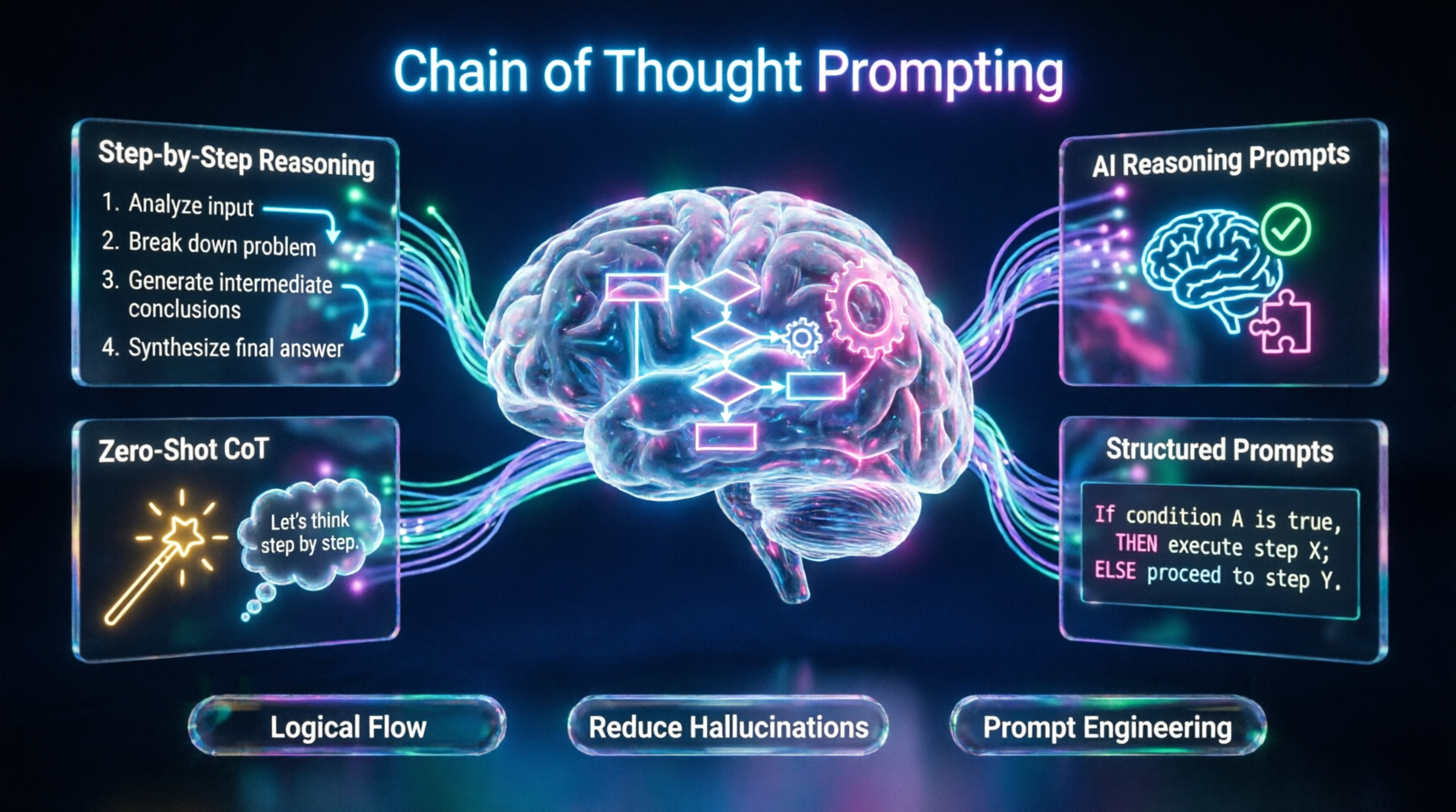
Mastering chain-of-thought prompting is the absolute best way to ensure your interactions with large language models transition from superficial, error-prone guesses to deep, logically sound, and highly accurate outputs. In an era where artificial intelligence is increasingly tasked with complex problem-solving, data analysis, and strategic planning, relying on basic, zero-shot queries is no longer a viable strategy for achieving reliable results. Today, forward-thinking prompt engineers, developers, and analysts are leveraging advanced step-by-step reasoning prompts to unlock the latent logical capabilities of modern AI. However, effectively designing these prompts requires a deep understanding of cognitive modeling and prompt architecture. If you are looking to understand exactly how to structure your inputs and select the right CoT prompting examples for your specific needs, you are in the right place.
This comprehensive guide demystifies the mechanics of advanced logical reasoning in AI. We will explore the foundational structures of AI reasoning prompts, detail the transformative power of the "let's think step by step prompt", and provide a strategic blueprint for crafting structured reasoning prompts. By the end of this article, you will have a clear, actionable framework for utilizing chain-of-thought ChatGPT techniques, learning how to improve AI reasoning with prompts, and choosing the perfect workflow that delivers maximum precision and value.
1. The Cognitive Leap: Why Chain of Thought Prompting Matters in 2026
Historically, users interacted with AI chatbots using simple, direct questions, often receiving broad, encyclopedic, or logically flawed answers. While large language models possess vast knowledge, they are fundamentally next-token predictors. Without explicit guidance to break down a problem, the model attempts to jump directly to the final answer, often resulting in "hallucinations" or arithmetic/logical errors. The emergence of sophisticated prompt engineering has introduced a paradigm shift: the ability to force the model to "show its work."
Understanding how to effectively use chain-of-thought prompting is critical because the model’s output accuracy is directly shaped by the intermediate reasoning steps you require it to generate. According to a 2026 Stanford Human-Centered AI Institute report on advanced prompting methodologies, users who employ structured chain of thought prompting techniques achieve a 75% higher accuracy rate in complex mathematical, logical, and analytical tasks compared to those using standard, unstructured queries. Therefore, aligning your request with precise reasoning frameworks is essential for professional-grade results.
2. Breaking Down the Mechanics: How Step-by-Step Reasoning Prompts Work
To make informed decisions, you must first understand the primary mechanics behind modern step-by-step reasoning prompts. Unlike traditional querying, which demands an immediate conclusion, chain of thought (CoT) prompting alters the generation trajectory of the model.
Intermediate Token Generation
When you prompt an AI to reason step-by-step, you are forcing it to generate intermediate tokens that represent logical deductions. These intermediate steps act as a "scratchpad" for the model. By the time the AI reaches the final conclusion, it has already contextualized the problem, reducing the cognitive load of trying to compute the answer and the logic simultaneously.
Error Self-Correction
One of the most powerful, yet underutilized, aspects of chain-of-thought prompting is its ability to facilitate self-correction. When a model articulates its reasoning, it can sometimes "catch" its own logical fallacies in the subsequent tokens, adjusting its final answer to be more accurate than it would have been in a zero-shot scenario.
Deconstructing Complexity
Complex problems are rarely solved in a single leap. Structured reasoning prompts force the AI to decompose a multifaceted problem into smaller, manageable sub-tasks, solving each sequentially before synthesizing a final, cohesive answer.
3. Practical Applications: Top CoT Prompting Examples for Complex Tasks
The versatility of AI reasoning prompts means they can be tailored to virtually any industry or workflow. Here are some high-impact CoT prompting examples across different domains:
Mathematical and Logical Problem Solving
Prompt: "A bat and a ball cost $1.10 in total. The bat costs $1.00 more than the ball. How much does the ball cost? Let's solve this step by step. First, define the variables. Second, set up the equation. Third, solve for the variable."
Why it works: It prevents the AI from relying on its training data's common misconception (answering $0.10) and forces algebraic deduction.
Business Strategy and Market Analysis
Prompt: "Act as a strategic consultant. Evaluate whether Company X should enter the Southeast Asian market. Use a step-by-step reasoning approach: 1. Analyze current market size and growth. 2. Identify top 3 competitors. 3. Assess regulatory barriers. 4. Provide a final go/no-go recommendation with a risk score."
Code Debugging and Optimization
Prompt: "Review the following Python function for potential bugs and performance bottlenecks. Think step by step: First, trace the execution flow. Second, identify any edge cases that might cause a crash. Third, suggest an optimized version of the code with explanations for each change."
4. The Magic Phrase: Leveraging the "Let's Think Step by Step" Prompt
One of the most famous and effective discoveries in prompt engineering is the zero-shot let's think step by step prompt. Introduced in seminal research, this simple phrase appended to the end of a query has been shown to dramatically improve performance on multi-hop reasoning tasks without requiring any prior examples.
Why the "Let's Think Step by Step" Prompt Works
This phrase acts as a universal trigger for the model's latent reasoning capabilities. It signals to the transformer architecture that the expected output format is not a direct answer but a sequential derivation. It is particularly effective when you do not have the time to craft a detailed, multi-step structured reasoning prompt but still need to avoid logical leaps.
Enhancing the Magic Phrase
While "let's think step by step" is powerful, you can amplify its effectiveness by combining it with role-playing. For example: "Act as a senior data scientist. Let's think step by step through this dataset anomaly." This combines the contextual priming of persona prompting with the logical scaffolding of CoT.
5. Advanced Techniques: How to Improve AI Reasoning with Prompts
For users who want to push the boundaries of chain-of-thought ChatGPT and other advanced models, understanding nuanced techniques is crucial for squeezing out the last drops of performance.
Few-Shot Chain of Thought
While zero-shot CoT is great, few-shot CoT is the gold standard. By providing 2-3 examples in your prompt that explicitly show the question, the step-by-step reasoning, and the final answer, you give the model a perfect template to mimic. This is one of the most reliable ways to improve AI reasoning with prompts.
Self-Consistency Decoding
Instead of generating a single chain of thought, advanced users prompt the model to generate multiple, independent chains of thought for the same problem and then take a "majority vote" on the final answer. While this requires API-level access or multiple generations, it drastically reduces the chance of a single logical hallucination.
Negative Chain of Thought
Instructing the model on what not to do in its reasoning can be highly effective. For example: "Think step by step, but do not make assumptions about user intent without explicit data. If data is missing, state that clearly in step 2 before proceeding."
6. Best Practices for Structured Reasoning Prompts in Enterprise Workflows
Implementing chain-of-thought prompting at scale requires standardization. Here are best practices for integrating these techniques into your team's daily operations.
Use Delimiters for Clarity.
Always use clear delimiters (like, or <step>) to separate your instructions, the context, and the expected reasoning format. This prevents the model from confusing the problem statement with the reasoning instructions.
Standardize Internal Prompt Libraries
Create a centralized repository of vetted structured reasoning prompts for common business tasks (e.g., financial forecasting, legal clause analysis, customer complaint triage). This ensures consistency and quality across your organization, preventing individual employees from reinventing the wheel.
Evaluate and Iterate
Do not assume a CoT prompt is perfect on the first try. Test your prompts against a "golden dataset" of known inputs and expected outputs. If the model's reasoning drifts, refine the prompt by adding more specific constraints to the intermediate steps.
7. Comprehensive Query Coverage
What is chain-of-thought prompting, and why is it important?
Chain-of-thought prompting is a technique where you instruct an AI model to break down a complex problem into intermediate, logical steps before providing a final answer. It is important because it significantly reduces hallucinations and improves accuracy in math, logic, and complex analytical tasks.
How do I write effective step-by-step reasoning prompts?
To write effective step-by-step reasoning prompts, explicitly instruct the model to outline its process. Use phrases like "First, analyze X. Second, calculate Y. Finally, conclude Z." Providing a clear, numbered structure guides the AI's token generation toward a logical progression.
Can you provide reliable CoT prompting examples for business?
Yes. A reliable business CoT example is "Evaluate this customer churn data. Step 1: Identify the top 3 reasons for churn mentioned in the text. Step 2: Correlate these reasons with customer tenure. Step 3: Recommend two actionable retention strategies based on this correlation."
Does the "let's think step by step" prompt really work?
Yes, the let's think step by step prompt is a proven, zero-shot technique that triggers the model's latent reasoning abilities. While not as precise as few-shot CoT, it is a highly effective, quick way to improve AI reasoning with prompts for moderately complex tasks.
How can I improve AI reasoning with prompts for coding tasks?
To improve AI reasoning with prompts for coding, ask the model to "think step by step" through the algorithm's logic, identify potential edge cases, and explain the time and space complexity before it writes the actual code. This prevents it from generating syntactically correct but logically flawed code.
Conclusion
Mastering chain-of-thought prompting is no longer just a niche skill for AI researchers; it is a fundamental requirement for anyone looking to extract reliable, high-quality, and logically sound value from large language models. By moving beyond basic queries and understanding the nuances of step-by-step reasoning prompts, the strategic use of the let's think step by step prompt, and how to craft robust structured reasoning prompts, you can ensure your AI interactions yield professional-grade results every time.
Whether you are utilizing chain-of-thought ChatGPT techniques to debug complex code, analyze financial data, or develop strategic business plans, the key to success lies in forcing the model to articulate its logic.
As artificial intelligence continues to evolve, the ability to effectively guide a model's reasoning process will remain the most powerful lever for controlling AI behavior and eliminating hallucinations. Embrace the power of AI reasoning prompts today, and position your workflows at the absolute forefront of the intelligent productivity revolution.



Comments
Comments are closed.